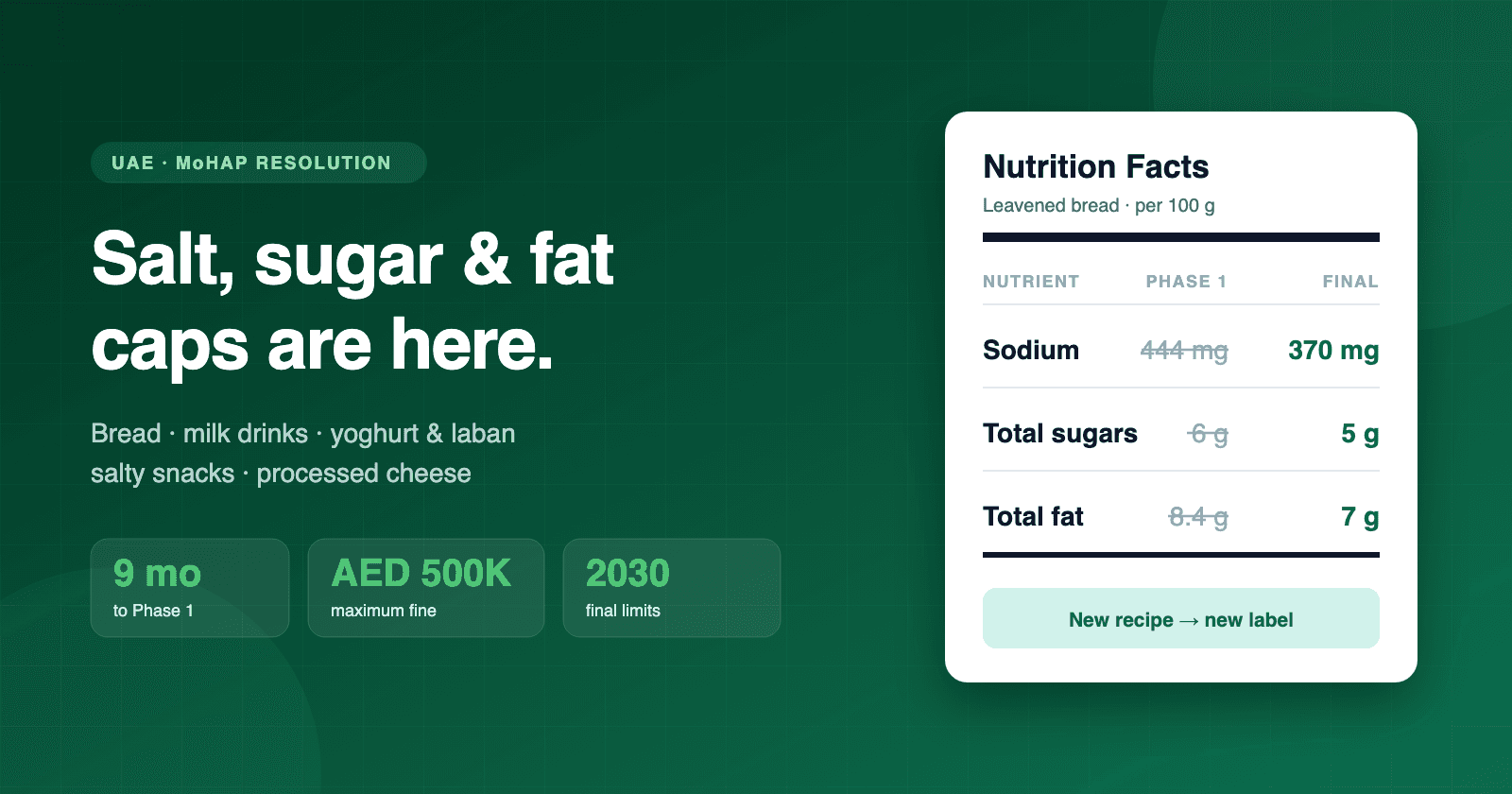
The UAE now caps how much sodium, sugar and fat ten kinds of packaged food can contain. Under a resolution the Ministry of Health and Prevention (MoHAP) began implementing on 6 October 2026, bread, sweetened milk drinks, flavoured yoghurt and laban, salty snacks and processed cheese must stay under maximum limits per 100 g. The limits tighten in two phases, the final limits apply from 31 December 2030, and fines reach AED 500,000[1].
The first deadline is closer than it looks. Bread, dairy drinks, yoghurt and snacks have nine months from the date the resolution takes effect to meet the first-phase caps.[1] And a product that only just meets those caps still needs another 16.7% cut before 2030. This guide covers every limit, deadline and exception rule in the official announcement, where the numbers come from, and what R&D, QA and regulatory teams should do first.
Key Takeaways
- Ten product lines, three nutrients. Sodium is capped in bread, salty snacks and processed cheese. Total sugars are capped in bread, sweetened milk drinks and flavoured yoghurt and laban. Total fat is capped in bread only.[1]
- Each Phase 1 cap is the final cap plus 20%. Design to the final number now, or you will reformulate twice.[1]
- Group 1 has 9 months, processed cheese has 2 years and 3 months, and every product must meet its final limit by 31 December 2030. Existing stock can stay on sale for up to one year, or until it expires if that comes first.[1]
- An exception is possible but narrow. It applies only if Phase 1 would force a cut of more than 20%, you must apply within 30 days of the effective date with accredited lab results, and it never moves the 2030 deadline.[1]
- It covers local and imported packaged food, free zones included. Penalties run from a warning to fines of AED 5,000 to AED 500,000, closure for up to six months, or licence cancellation.[1]
- The final caps closely track the WHO's 2021 global sodium benchmarks. The 320 mg flatbread limit, for example, is the same as the WHO benchmark, which was itself based on Qatar's national target.[3][4]
Every recipe you reformulate needs a new nutrition label
Cut the salt, sugar or fat and the nutrition panel on the pack changes with it, often the ingredient list too. RecipeBuilder produces nutrition labels that meet UAE requirements straight from your recipes, so your packs match your new formulas before the Phase 1 deadline.
- Approved by Dubai Municipality or your money back (see the terms)
- Unlimited change requests, so every reformulation round is covered
What Does the UAE's New Salt, Sugar and Fat Resolution Do?
The resolution sets a national framework to gradually reduce "all types of sodium", sugar and fat in selected food products, in clearly defined phases that run to the end of 2030, according to the official announcement from WAM, the UAE's state news agency[1]. MoHAP says the aim is to protect public health and reduce obesity and other noncommunicable diseases linked to unhealthy food.
The approach is reformulation, not a tax. Dr Ahmed Al Khazraji, Executive Director of Healthy Living at the Department of Health – Abu Dhabi, described the goal as to "improve the nutritional profile of products that people already buy and enjoy"[15]. In practice, the burden falls on product developers, not on shoppers.
One wording point matters for compliance teams. WAM's summary says "processed sugar", but every sugar limit in the resolution is written as total sugars. This guide uses "total sugars" throughout.
Is Your Product Covered?
According to WAM's summary of the resolution, a product is in scope when all three answers are yes:
Two practical consequences are easy to miss:
- Importers, distributors and retailers are covered, not just manufacturers. Once the stock window ends, no establishment may trade a non-conforming product.[1] If you import crackers or processed cheese, your supplier's recipe is now your compliance problem.
- The announcement refers to packaged food. It does not mention bread sold unpackaged at a bakery counter.[1] Until the full text or implementing decisions say otherwise, confirm the status of unpackaged products with your health authority before assuming they are exempt.
RecipeBuilder automates this. Generate compliance-ready nutrition labels, manage your allergen database, and track recipe costs — all from one platform built for food businesses in the UAE and beyond.
Book a callEvery UAE Salt, Sugar and Fat Limit in One Table
| Product line | Sodium | Total sugars | Total fat | Phase 1 due |
|---|---|---|---|---|
| Leavened and flat bread | ✓ | ✓ | ✓ | 9 months |
| Sweetened milk drinks | – | ✓ | – | 9 months |
| Flavoured yoghurt and laban | – | ✓ | – | 9 months |
| Salty snacks (4 types) | ✓ | – | – | 9 months |
| Processed cheese (2 types) | ✓ | – | – | 2 years 3 months |
All limits are per 100 g of product, as published by WAM.[1] The salt column converts each sodium limit using the WHO factor of 1 g of salt = 400 mg of sodium[5].
| Group | Product | Nutrient | Phase 1 limit | Final limit | Final limit as salt |
|---|---|---|---|---|---|
| 1 | Leavened bread | Sodium | 444 mg | 370 mg | ≈ 0.93 g |
| 1 | Leavened bread | Total sugars | 6 g | 5 g | – |
| 1 | Leavened bread | Total fat | 8.4 g | 7 g | – |
| 1 | Flat bread | Sodium | 384 mg | 320 mg | 0.80 g |
| 1 | Flat bread | Total sugars | 6 g | 5 g | – |
| 1 | Flat bread | Total fat | 8.4 g | 7 g | – |
| 1 | Sweetened milk drinks, including milk alternatives | Total sugars | 9.6 g | 8 g | – |
| 1 | Sweetened or flavoured yoghurt and laban | Total sugars | 12 g | 10 g | – |
| 1 | Salted crackers | Sodium | 696 mg | 580 mg | 1.45 g |
| 1 | Salted nuts and seeds | Sodium | 336 mg | 280 mg | 0.70 g |
| 1 | Pretzels | Sodium | 912 mg | 760 mg | 1.90 g |
| 1 | Extruded snacks and chips (potato, sweet potato, vegetable or grain) | Sodium | 564 mg | 470 mg | ≈ 1.18 g |
| 2 | Spreadable processed cheese | Sodium | 864 mg | 720 mg | 1.80 g |
| 2 | Other processed cheese | Sodium | 1,200 mg | 1,000 mg | 2.50 g |
Two more details in the table change how you plan:
- "Total sugars" includes the sugar already in milk. Codex defines sugars as "all mono-saccharides and di-saccharides present in food"[6]. Lactose therefore counts toward the milk drink and yoghurt caps, which leaves far less room for added sugar than the headline number suggests.
- The fat cap is total fat, and it applies to bread only. There is no separate saturated-fat cap, and no fat limit for snacks or cheese.[1]
The Deadlines, and the One Date Nobody Has Published Yet
Every deadline in the resolution counts from "the date it takes effect". As of 21 October 2026, that date has not been published. MoHAP announced that implementation began on 6 October 2026,[1] and the resolution text was not yet searchable on the UAE Legislation platform[16] when we checked. The timeline below shows what each deadline would be if the effective date turns out to be 6 October 2026. Treat the "≈" dates as planning estimates, not legal dates.
Nine months is short for reformulation. A recipe change usually has to go through bench trials, sensory testing, shelf-life validation, supplier changes, label redesign and registration updates before it reaches the shelf. Working back from July 2027, Group 1 teams should be choosing reformulation candidates now.
The 20% Exception: Who Qualifies and What to File
The resolution lets an establishment ask MoHAP for an exception from the Phase 1 limit, under strict conditions[1]:
- The test: meeting the Phase 1 limit would mean cutting the target ingredient by more than 20% of its established content in the product.
- Eligible products: only products manufactured, imported or traded in the UAE before the effective date. New launches do not qualify.
- The deadline: apply within 30 days of the effective date.
- The evidence: technical data, the registered nutrition label data, and test results from an accredited laboratory.
- The commitment: you must still cut the ingredient by at least 20% within the Phase 1 period.
- The limit: an exception does not exempt the product from the limits, and it cannot push compliance past 31 December 2030.
Worked example: a flatbread at 520 mg sodium
The exception buys time in Phase 1. It does not change where the product has to end up. Because the evidence must come from an accredited laboratory, recipe calculations are useful for working out which SKUs are likely to qualify, but they cannot replace the lab report in the application. The announcement also does not say how "established content" is set: from the registered label, a lab result or a product specification. Ask MoHAP before you rely on any one of them.
Whether you apply for an exception or reformulate straight away, the label on the pack has to match what is inside it, at every step down to the final limit. Book a call to see how RecipeBuilder turns each revised recipe into a UAE-compliant nutrition label, with unlimited change requests included.
Where Did These Numbers Come From? (Hint: the WHO)
The final UAE limits are close to, and in places identical to, the WHO global sodium benchmarks for different food categories[3], published in May 2021. WHO collected sodium targets from 41 countries, one WHO region and one WHO subregion, and in principle chose the lowest existing national or regional target for each subcategory as the benchmark[4].
Show as table
| Category | WHO benchmark (mg sodium / 100 g) | Country the benchmark is based on | UAE final limit | UAE vs WHO |
|---|---|---|---|---|
| Leavened bread | 330 | Hungary | 370 | 12% higher than WHO |
| Flatbreads | 320 | Qatar | 320 | Same |
| Crackers / savoury biscuits | 600 | Paraguay | 580 | Stricter |
| Nuts, seeds and kernels | 280 | Colombia | 280 | Same |
| Pretzels | 760 | – | 760 | Same |
| Potato, vegetable and grain chips | 500 | Australia | 470 | Stricter |
| Extruded snacks | 520 | – | 470 | Stricter |
| Processed cheese | 720 | United Kingdom | 720 (spreadable) / 1,000 (other) | Same / higher |
This tells you two things. First, the targets are not arbitrary: other countries already reach them in real products. Second, the gap between the UAE's Phase 1 caps and its final caps is mainly an on-ramp to an international benchmark. Expect regional and export customers to use the same numbers.
Within the GCC, Saudi Arabia went first on bread. Since 30 April 2019, SFDA technical regulation SFDA.FD 2362/2018 has limited salt in bread to no more than 1 g per 100 g of finished product[9], which works out to about 400 mg of sodium[5]. The UAE's final limits for leavened bread (370 mg) and flat bread (320 mg) are stricter, and they also cover sugar and fat.
Why the UAE Is Doing This Now
The trigger was the evidence. MoHAP's WHO-endorsed National Health and Nutrition Survey 2024–2025 covered 20,000 households and 2,000 people living in workers' accommodation, and was published on 6 January 2026[2].
Health Minister Ahmed Ali Al-Sayegh said the findings "reinforce the importance of prevention, early intervention, and long-term planning."[2]
Independent measurement points the same way. A peer-reviewed study of 190 healthy UAE adults measured average sodium excretion of 2,816 mg a day, roughly 7 g of salt, with 65.3% above the WHO limit. Only about 35% of participants recognised Arabic and Iranian breads as high in sodium[10]. For comparison, the WHO recommends less than 2,000 mg of sodium (5 g of salt) a day for adults, and estimates that excess sodium was associated with 1.7 million deaths in 2023[5].
The caps are one part of a wider set of measures:
For a manufacturer, these measures reinforce each other. A lower-sodium, lower-sugar recipe helps you meet the cap, can lower your sugar tax, and can improve your SEHHI and Nutri-Mark position.
How to Hit the Limits, Category by Category
The research is consistent on one point: gradual reduction, tested with consumers at each step, is less risky than one large cut. The WHO lists reformulating foods to contain less salt, and setting target levels for salt in foods, among its most cost-effective "best buy" interventions[5]. Here is what the evidence says for each category.
Bread: sodium, sugar and fat
Salt is not just a flavour in bread. It controls fermentation, strengthens the gluten network, and affects how the dough handles, the loaf volume, shelf life and taste. A review in Critical Reviews in Food Science and Nutrition sets out these technical and quality problems and assesses common ways to replace sodium chloride[11]. Adding sourdough is one of the more promising ways to win back flavour and shelf life in reduced-salt bread[12]. Salt replacers such as potassium chloride are another option the research assesses[11][12]; trial them in small steps with sensory testing. Most plain loaves will mainly need sodium work. The 5 g sugar and 7 g fat caps are more likely to affect enriched products such as milk bread, brioche-style loaves and sweet or flavoured flatbreads.
Sweetened milk drinks: the lactose trap
Plain milk already contains about 4–5 g of sugar per 100 ml, all of it lactose, and commercial chocolate milks range from about 8% to 13% total sugar[13]. Because lactose counts toward total sugars, a final cap of 8 g leaves only about 3–4 g per 100 g for added sugar.
Flavoured yoghurt and laban
The same lactose rule applies[6]. Most of the room under the 10 g final cap goes to the milk base, so the sugar in a fruit preparation or syrup is what you can actually change. The industry has started already: Al Ain Farms Group says it has cut added sugar by 10% to 20% in some juices, flavoured milks, flavoured yoghurts and laban, and Arla says it is reformulating products[15].
Salty snacks: crackers, nuts and seeds, pretzels, chips and extruded snacks
Snacks have only sodium limits, and two of them are stricter than the WHO benchmarks (chips and extruded snacks at 470 mg)[1][3]. A practical starting point is the seasoning: its blend and its application rate. Then confirm the result on finished-product samples, not just on the formula. Salted nuts and seeds carry the lowest sodium cap in the whole resolution, 280 mg[1], so they have the least room for error.
Processed cheese: sodium from emulsifying salts
In processed cheese, sodium comes from the sodium phosphate and citrate emulsifying salts as well as from added salt. A study in the International Dairy Journal found that replacing 15% of the sodium in phosphate emulsifying salts with potassium kept the viscosity close to the reference and most samples acceptable, while 30% lowered the viscosity slightly[14]. Sodium also helps keep processed cheese microbiologically safe, so plan challenge tests alongside sensory work. Group 2's 27-month Phase 1 window[1] reflects how hard this category is. Use the time.
What to Do in the Next 30 Days
These steps are in the order that protects your options. Use the exception window and the nine-month clock as your planning horizon.
1. List every affected SKU, including imports and private label
List every SKU in the ten product lines that you make, import, distribute or sell under your own brand, free-zone and private label included. Retailers and distributors should include supplier products.
2. Get a sodium, total sugars and total fat value per 100 g for each SKU
Start with registered label data and check it against recipe-level nutrition calculations. Send products with no reliable data, or close to a cap, for accredited lab testing. Use total sugars, including lactose[6].
3. Score each SKU against both the Phase 1 and the final limit
Sort every SKU into one of three groups, and calculate the percentage cut each red SKU needs:
4. Decide on exceptions before the 30-day window closes
Any red SKU needing more than a 20% cut is a candidate[1]. Gather technical data, registered label data and accredited lab results now, and confirm the process and the meaning of "established content" with MoHAP.
5. Reformulate to the final limit, not the Phase 1 limit
Phase 1 is only 20% above the final limit[1]. Designing straight to the final limit saves a second round of trials, sensory panels, shelf-life studies and label changes.
6. Update labels, registrations and supplier specifications together
A new recipe changes the nutrition declaration, sometimes the ingredient list and allergens too. Keep recipe, label artwork, registration data and supplier specs under one change record.
Reformulated? Your Label and Registration Data Must Follow
The resolution does not add new labelling rules, but it relies on your existing ones. Exception applications must include registered nutrition label data[1], and inspectors will compare products against the limits. Each reformulation therefore sets off a chain:
What the Official Announcement Doesn't Tell You Yet
Several questions remain open as of 21 October 2026. Check each with MoHAP or your local health authority before relying on it:
We will update this guide when the full text and implementing decisions are published.
How RecipeBuilder Keeps Your Labels Compliant Through Reformulation
RecipeBuilder is nutrition labeling software for food businesses in the UAE and the wider region. Reformulating to the caps is rarely one change: most products will go through several recipe versions on the way to the final limit, and each one needs a label that matches it. RecipeBuilder builds that label from the recipe itself:
Evaluating tools? See how RecipeBuilder compares with NutriCal, Food Label Maker and other nutrition label software, or check plans and pricing.
Keep in mind that for exception applications, the resolution requires test results from an accredited laboratory[1].
Get UAE-compliant labels for every reformulated product
Book a call and we will show you how RecipeBuilder turns your recipes into labels that meet UAE requirements, and how the guarantee works for your product range.
- Approved by Dubai Municipality or your money back (see the terms)
- Unlimited change requests
Frequently Asked Questions
What are the UAE's new salt, sugar and fat limits?
They are maximum levels of sodium, total sugars and total fat per 100 g, set by a resolution that MoHAP began implementing in October 2026, for leavened and flat bread, sweetened milk drinks, flavoured yoghurt and laban, salted crackers, salted nuts and seeds, pretzels, chips and extruded snacks, and processed cheese. Each product has a Phase 1 limit and a stricter final limit due by 31 December 2030. For example, leavened bread goes from 444 mg to 370 mg of sodium per 100 g.[1]
Do the limits apply to imported food and free-zone companies?
Yes. According to WAM's summary, the resolution covers packaged foods that are made locally or imported, and all food establishments in the UAE that handle them, including free-zone companies. Products made or imported only for export or re-export are excluded unless they are also sold in the UAE.[1]
Does lactose count toward the sugar limit for milk drinks and yoghurt?
The limits are for total sugars, and Codex defines sugars as all monosaccharides and disaccharides present in food, which includes the lactose naturally present in milk. Plain milk already contains about 4 to 5 g of sugar per 100 ml, so the 8 g final cap for sweetened milk drinks leaves only about 3 to 4 g for added sugar.[6][13]
When do the UAE sodium limits take effect?
MoHAP began implementing the resolution on 6 October 2026, but the exact effective date had not been published as of 21 October 2026. Bread, sweetened milk drinks, flavoured yoghurt and laban, and salty snacks must meet Phase 1 limits within 9 months of the effective date. Processed cheese has 2 years and 3 months. All products must meet final limits by 31 December 2030.[1]
What is the fine for exceeding the UAE salt, sugar and fat limits?
Depending on how serious the violation is, the circumstances and whether it is repeated, penalties range from a warning, to an administrative fine of AED 5,000 to AED 500,000, to closure of the establishment for up to six months (renewable), to cancellation of its licence or approval. The Cabinet will issue the detailed list of violations and penalties.[1]
Can a company get an exception from the limits?
Only from the Phase 1 limit, and only for products already on the UAE market before the effective date, where meeting Phase 1 would require cutting the ingredient by more than 20%. The application must be made to MoHAP within 30 days of the effective date, with technical data, registered nutrition label data and accredited laboratory results. The company must still cut the ingredient by at least 20% during Phase 1, and the 31 December 2030 final deadline still applies.[1]
Can old stock still be sold after the deadlines?
Stock manufactured or imported before the resolution takes effect can stay on sale for up to one year from the effective date, or until it expires if that comes first. After that, no product that exceeds the applicable limit may be traded in the UAE.[1]
Is this the same as Abu Dhabi's Nutri-Mark?
No. Nutri-Mark is an Abu Dhabi front-of-pack nutrition grade from A to E that is currently voluntary. The MoHAP resolution applies across the UAE and sets mandatory maximum limits on product composition. A product can comply with the caps and still carry a low Nutri-Mark grade, but reformulating to the caps will often improve the grade. See our Nutri-Mark guide.
Related Resources
Sources
- WAM (Emirates News Agency): MoHAP starts implementing resolution setting caps on levels of sodium, sugar, fats in selected food products (6 October 2026)
- WAM (Emirates News Agency): MoHAP releases National Health and Nutrition Survey 2024-2025 (6 January 2026)
- World Health Organization: WHO global sodium benchmarks for different food categories (3 May 2021)
- World Health Organization: Launch presentation on the WHO global sodium benchmarks (5 May 2021)
- World Health Organization: Sodium reduction fact sheet
- FAO/WHO Codex Alimentarius: Guidelines on Nutrition Labelling (CAC/GL 2-1985)
- UAE Federal Tax Authority: Calculating excise tax for sweetened drinks (tiered-volumetric model)
- Abu Dhabi Media Office: Responsible placement of food and beverage policy for supermarkets and their online platforms
- Saudi Food and Drug Authority: SFDA sets limit levels of salt in bread (2019)
- Jarrar AH et al. Salt-related knowledge, attitudes and practices and 24-h urinary sodium and potassium excretion in UAE residents. Public Health Nutrition 27(1):e235 (2024)
- Belz MCE, Ryan LAM, Arendt EK. The impact of salt reduction in bread: a review. Critical Reviews in Food Science and Nutrition 52(6):514–524 (2012)
- Silow C, Axel C, Zannini E, Arendt EK. Current status of salt reduction in bread and bakery products – a review. Journal of Cereal Science 72:135–145 (2016)
- Mahato DK et al. Sugar reduction in dairy food: an overview with flavoured milk as an example. Foods 9(10):1400 (2020)
- Mozuraityte R et al. Sodium reduction in processed cheese spreads and the effect on physicochemical properties. International Dairy Journal 90:45–55 (2019)
- The National: UAE drive to cut sugar, salt and fat in food to make healthy choices easier, experts say (8 October 2026)
- UAE Legislation platform (searched for the resolution text) (checked 21 October 2026)